
Introduction
Much of the contemporary discussion surrounding generative AI assumes that the primary organisational challenge is technological adoption. The central question often appears to be whether firms will use artificial intelligence and how quickly adoption will occur. While adoption is undoubtedly important, this perspective risks overlooking a more fundamental issue. The strategic value of generative AI depends not only on what the technology produces but also on how managers interpret, evaluate, and act upon its outputs.
Generative AI systems can summarise information, generate scenarios, identify patterns, and produce recommendations with remarkable speed. However, these outputs do not automatically become organisational decisions. They must first pass through processes of interpretation and judgement. Managers must decide what the output means, whether it is credible, how it relates to organisational goals, and whether it warrants action.
For this reason, the growing integration of generative AI into managerial work should not be understood purely as a process of automation. Rather, it should be understood as a process of organisational sensemaking.
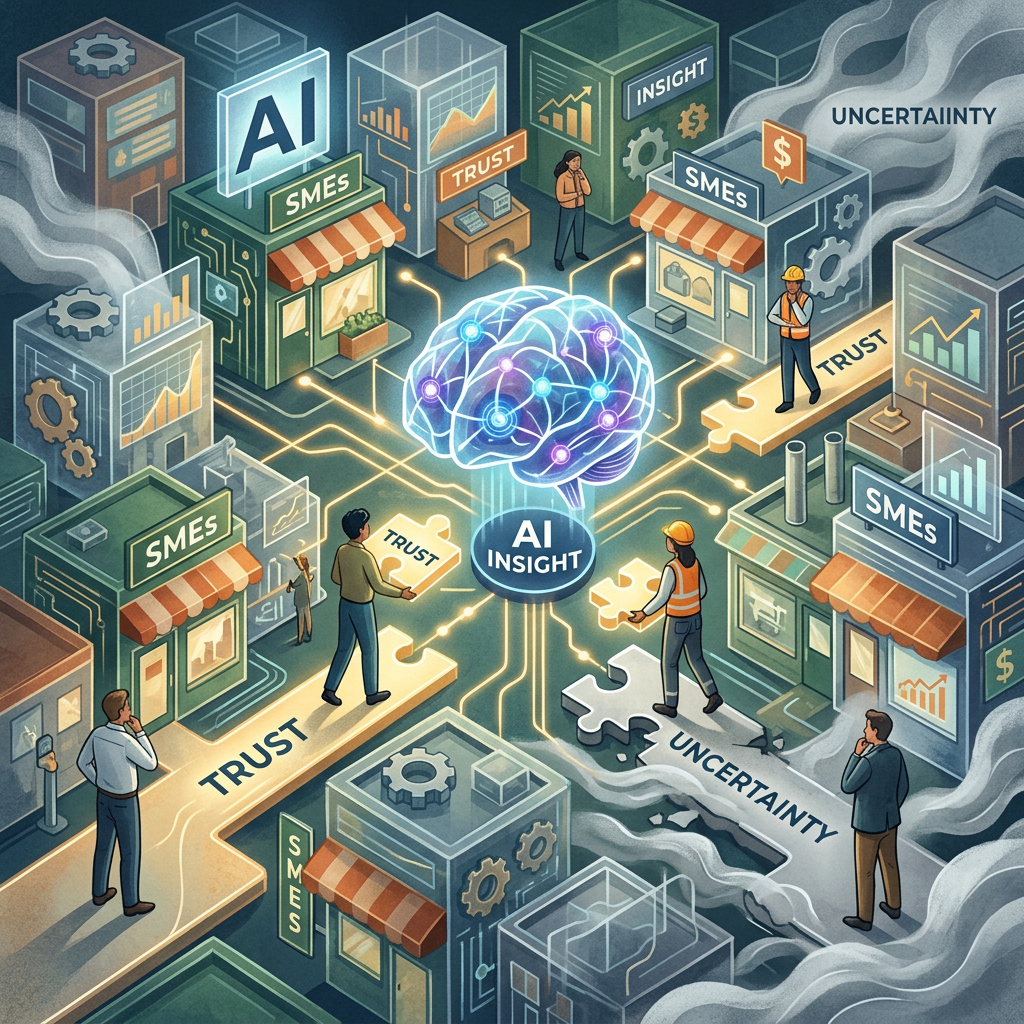
This article argues that the strategic impact of generative AI in small and medium-sized enterprises (SMEs) is best understood through the lens of sensemaking. AI-generated outputs do not replace managerial judgement; they become inputs into ongoing processes through which managers construct meaning under conditions of ambiguity and uncertainty. Consequently, the future of AI-enabled decision-making depends not only on technological capability but also on how organisational actors make sense of what AI is telling them.
The limits of the automation narrative
The dominant narrative surrounding artificial intelligence often presents AI as a tool for replacing or automating human cognitive tasks. Within this view, technological progress is measured primarily by improvements in speed, efficiency, and predictive capability.
While these developments are significant, they provide only a partial understanding of what occurs inside organisations.
Managers rarely encounter decisions that are purely technical. Strategic issues are often characterised by uncertainty, competing objectives, incomplete information, and conflicting interpretations. Questions concerning market expansion, product development, investment priorities, workforce planning, or organisational change cannot be resolved solely through data processing.
Even when AI systems provide recommendations, managers must still determine:
- What problem is actually being addressed?
- Which assumptions underpin the recommendation?
- How does the recommendation fit organisational realities?
- What risks might the system have overlooked?
- How should competing interpretations be evaluated?
These questions cannot be automated away. They require judgement, interpretation, and contextual understanding.
As a result, the most important organisational consequence of generative AI may not be the automation of decision-making but the transformation of how managers construct meaning around strategic issues.
Understanding sensemaking
The concept of sensemaking is most closely associated with the work of Karl Weick, whose research emphasised how organisational actors create meaning in ambiguous situations.
Sensemaking refers to the process through which individuals interpret events, extract cues from their environment, and construct plausible explanations that enable action. Rather than assuming that managers simply discover objective reality, sensemaking suggests that managers actively participate in creating meaningful interpretations of that reality.
This perspective is especially valuable when examining AI-enabled decision-making because generative AI frequently produces outputs that are open to multiple interpretations.
An AI-generated market analysis, for example, does not arrive with a universally agreed meaning. Different managers may interpret the same output differently depending on their experiences, expertise, priorities, and assumptions.
One manager may see opportunity.
Another may see risk.
A third may question the validity of the underlying analysis altogether.
The output remains the same, but the interpretation varies.
This observation highlights a critical point: AI does not eliminate sensemaking. In many cases, it increases the need for it.
Why AI outputs require interpretation
Generative AI systems produce outputs that are often coherent, persuasive, and professionally written. This fluency creates an important organisational challenge.
Managers may mistakenly assume that a well-presented output is necessarily a reliable one.
Yet generative AI does not truly understand organisational context. It does not possess tacit knowledge, political awareness, historical memory, or lived experience within a firm. Instead, it generates responses based on statistical relationships learned during training.
Consequently, AI outputs often require substantial interpretation.
Consider a scenario in which an SME manager asks a generative AI system whether the firm should enter a new market.
The system may provide:
- market opportunities
- competitor analysis
- potential risks
- customer segments
- strategic recommendations
At first glance, this appears highly useful.
However, managers must still determine:
- whether the analysis reflects current market conditions
- whether the assumptions are realistic
- whether the recommendations fit organisational capabilities
- whether critical information has been omitted
- whether the suggested strategy aligns with long-term objectives
These evaluations are fundamentally interpretive activities.
The strategic value of the output therefore depends not solely on the AI system but on the quality of managerial sensemaking surrounding that output.
AI as a source of cues
A useful way to conceptualise generative AI is to view it as a producer of organisational cues.
Within sensemaking theory, cues are pieces of information that individuals notice and use to construct understanding. Managers continuously extract cues from reports, conversations, market developments, customer behaviour, and organisational events.
Generative AI introduces a new source of cues into this process.
The technology can highlight trends, generate alternative explanations, identify possible scenarios, and surface considerations that managers may not have previously recognised.
This capability can be valuable because it expands the range of information available for interpretation.
However, cue generation is not the same as meaning generation.
AI can provide cues.
Managers must determine what those cues mean.
This distinction is crucial because organisational action is based not on information alone but on interpretations of information.
Plausibility versus accuracy
One of the most influential ideas within sensemaking theory is that organisational actors often operate according to plausibility rather than certainty.
Managers frequently make decisions before complete information is available. Under uncertainty, waiting for perfect knowledge is rarely feasible. Instead, decision-makers construct explanations that are sufficiently plausible to support action.
This insight is particularly relevant in the context of generative AI.
Generative AI systems are exceptionally effective at producing plausible outputs. Responses are often coherent, convincing, and internally consistent. Yet plausibility should not be confused with accuracy.
A recommendation can appear highly credible while containing flawed assumptions, incomplete evidence, or incorrect conclusions.
The challenge for managers is therefore not simply to evaluate whether an AI output sounds convincing but to determine whether it provides a sufficiently robust basis for action.
This requires critical reflection rather than passive acceptance.
In practice, effective managerial use of AI may depend less on identifying perfect answers and more on developing the capacity to distinguish between plausible narratives and genuinely useful strategic insights.
Sensemaking under uncertainty
The importance of sensemaking becomes particularly visible under conditions of uncertainty.
SMEs frequently operate in environments characterised by:
- changing customer preferences
- economic volatility
- resource constraints
- technological disruption
- competitive pressure
These conditions create ambiguity regarding both problems and solutions.
Generative AI may help managers process information more efficiently, but it cannot eliminate uncertainty itself.
Indeed, AI sometimes introduces new forms of uncertainty.
Managers may question:
- where information originated
- whether assumptions are valid
- how recommendations were generated
- whether important contextual factors are missing
As a result, AI adoption often shifts uncertainty rather than removing it.
Managers move from asking:
“What should we do?”
to asking:
“How should we interpret what the AI is suggesting?”
This shift highlights why sensemaking remains central to strategic decision-making despite advances in AI capability.
The danger of outsourced thinking
One of the most significant risks associated with generative AI is not technological failure but cognitive dependency.
As AI systems become increasingly capable, managers may gradually transfer interpretive responsibilities to the technology itself.
Instead of using AI as a tool for exploration, they may begin treating it as an authority.
This creates several risks:
Premature closure
Managers may stop searching for alternative explanations because the AI has already produced a plausible answer.
Reduced critical reflection
The persuasive nature of AI-generated content may discourage deeper evaluation.
Narrow framing
Managers may become anchored to the problem definition implied by the AI response.
Overconfidence
Confidence in AI outputs may exceed their actual reliability.
Collectively, these tendencies can weaken rather than strengthen organisational judgement.
The challenge is therefore not simply to increase AI use but to ensure that AI use supports rather than replaces managerial thinking.
What effective sensemaking with AI might look like
If generative AI is to enhance strategic decision-making, managers need practices that encourage active interpretation rather than passive acceptance.
Several principles appear particularly important.
1. Treat AI outputs as provisional
Recommendations should be viewed as starting points for inquiry rather than final answers.
2. Seek alternative interpretations
Managers should explore multiple explanations, scenarios, and viewpoints before committing to action.
3. Challenge assumptions
Every recommendation contains assumptions. These assumptions should be identified and examined explicitly.
4. Compare AI insights with organisational knowledge
Outputs should be evaluated against internal experience, industry expertise, and contextual understanding.
5. Maintain human accountability
Responsibility for strategic decisions must remain with organisational actors rather than technological systems.
These practices help ensure that AI contributes to organisational learning rather than encouraging uncritical reliance.
Implications for future research
Current research on generative AI in organisations remains heavily focused on adoption, performance outcomes, and technical capability.
While these topics are important, greater attention should be devoted to the interpretive processes that connect AI outputs to organisational action.
Several questions deserve further investigation:
- How do managers interpret conflicting AI recommendations?
- How does organisational experience influence AI-related sensemaking?
- What factors shape the credibility assigned to AI outputs?
- How do SMEs develop routines for evaluating AI-generated information?
- Under what conditions does AI enhance or undermine managerial judgement?
Addressing these questions would provide a richer understanding of how AI becomes embedded within organisational decision-making processes.
Conclusion
The future of generative AI in organisations should not be understood solely as a story of automation.
The most significant organisational challenge is not whether AI can generate recommendations but how managers interpret those recommendations under conditions of uncertainty.
Generative AI does not eliminate the need for sensemaking. Instead, it introduces new cues, new ambiguities, and new interpretive demands into managerial work.
For SMEs, where strategic decisions often depend heavily on managerial judgement, this distinction is particularly important.
The organisations that benefit most from generative AI are unlikely to be those that automate thinking entirely. Rather, they will be those that combine technological capability with disciplined processes of interpretation, reflection, and critical evaluation.
Ultimately, the future of AI-enabled decision-making may depend less on the intelligence of machines and more on the quality of human sensemaking surrounding them.
Author Note
Saba Shahzadi is an emerging researcher whose work focuses on generative AI, organisational sensemaking, managerial decision-making, and SME digital transformation. Her research explores how managers interpret and use AI-generated outputs under conditions of uncertainty, with particular attention to trust calibration and human–AI collaboration.
Suggested References
Weick, K. E. (1995). Sensemaking in Organizations. Sage Publications.
Weick, K. E., Sutcliffe, K. M., & Obstfeld, D. (2005). Organizing and the Process of Sensemaking. Organization Science, 16(4), 409–421.
OECD. (2025). Generative AI and the SME Workforce: New Survey Evidence. OECD Publishing.
Maitlis, S., & Christianson, M. (2014). Sensemaking in Organizations: Taking Stock and Moving Forward. Academy of Management Annals, 8(1), 57–125.
 shahzadisaba4z-biesm