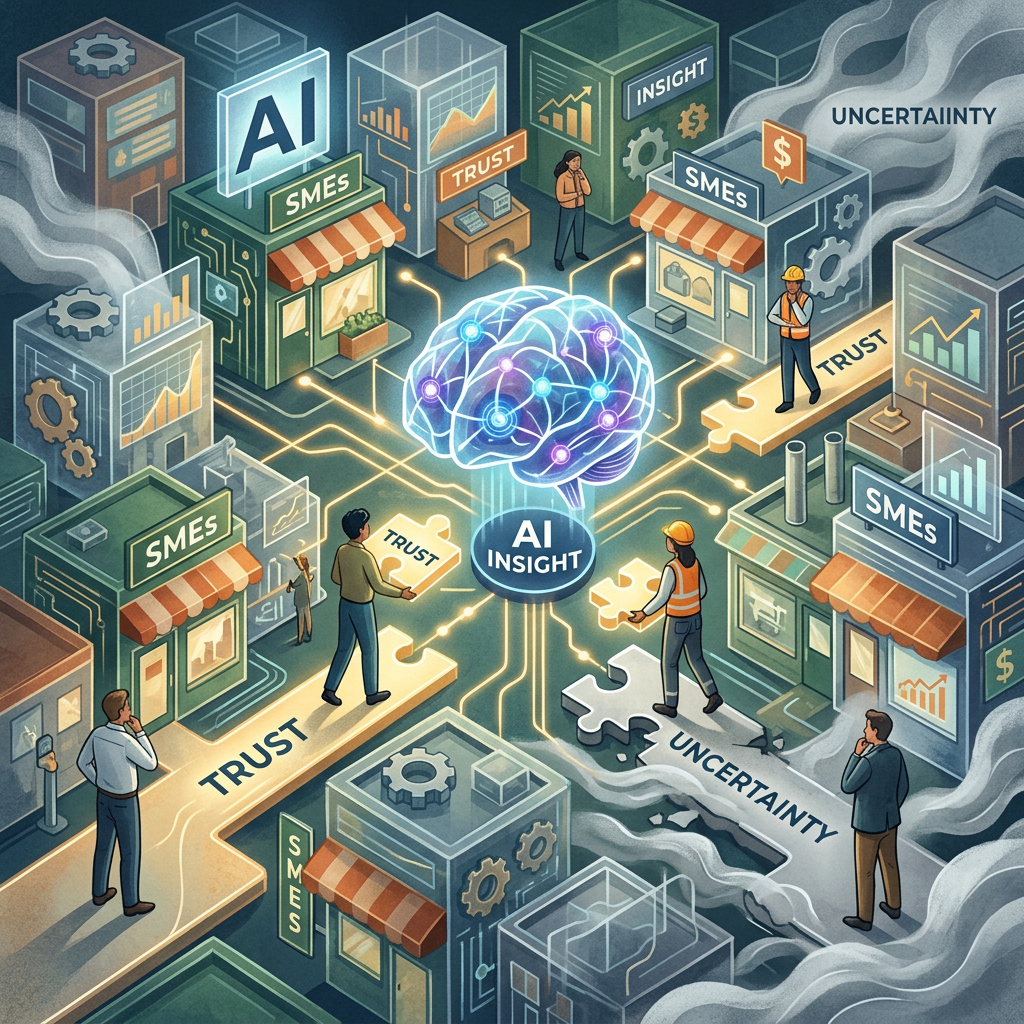
Tag: Strategic Decision-Making

  • Generative AI Is Changing Strategic Decision-Making, Not Because It Thinks Like Humans, but Because Humans Think Differently With It

    Generative AI Is Changing Strategic Decision-Making, Not Because It Thinks Like Humans, but Because Humans Think Differently With It

    Abstract

    Generative artificial intelligence (AI) is increasingly being integrated into organisational decision-making. However, much of the current discussion continues to frame AI as either a replacement for human cognition or as a productivity-enhancing tool. This article argues that these perspectives overlook a more fundamental transformation. The strategic importance of generative AI lies not in its capacity to make decisions independently but in its ability to reshape how managers construct, evaluate, and revise their own judgements. Drawing on organisational sensemaking, bounded rationality, and trust calibration, this article proposes that generative AI functions as a cognitive partner that alters managerial reasoning rather than replacing it. This perspective offers a richer explanation of AI-enabled decision-making in SMEs and identifies new directions for future research.


    Introduction

    Artificial intelligence is often discussed in terms of automation, efficiency, and productivity. Headlines frequently ask whether AI will replace managers, automate strategic planning, or outperform human decision-makers. Such questions, while important, may be asking the wrong thing.

    Managers rarely make strategic decisions in environments characterised by complete information and objective certainty. Instead, they operate within contexts shaped by ambiguity, incomplete knowledge, competing priorities, and organisational constraints. Under these conditions, strategic decision-making depends not only on information availability but also on interpretation.

    Generative AI changes this interpretive environment.

    Unlike previous generations of analytical technologies, large language models generate explanations, alternatives, summaries, scenarios, and recommendations that resemble human reasoning. These outputs influence not simply what managers know, but how they think about organisational problems.

    This article argues that the real contribution of generative AI is cognitive rather than computational. It changes managerial thinking by expanding, redirecting, and sometimes constraining the interpretive processes through which strategic decisions emerge.


    From Decision Support to Cognitive Partnership

    Traditional decision support systems were designed primarily to improve access to information.

    Generative AI performs a fundamentally different role.

    Rather than simply retrieving information, it actively generates possible interpretations, frames organisational problems in new ways, proposes strategic alternatives, and constructs persuasive narratives.

    Consequently, managers increasingly interact with AI through dialogue rather than command.

    This shift transforms AI from an information tool into what can be described as a cognitive partner.

    A cognitive partner does not make organisational decisions independently.

    Instead, it participates in the reasoning process by introducing new cues, challenging assumptions, generating counterfactual scenarios, and expanding the space of possible interpretations.

    The quality of managerial judgement therefore depends on the interaction between human cognition and AI-generated reasoning rather than either component operating in isolation.


    Theoretical Foundations

    Three complementary theoretical perspectives help explain this transformation.

    Bounded Rationality

    Managers cannot process unlimited information or evaluate every possible strategic alternative.

    Generative AI partially reduces these cognitive constraints by accelerating information synthesis and option generation.

    However, reducing information-processing costs does not eliminate bounded rationality.

    Instead, the boundaries themselves shift.

    Managers increasingly face new limitations concerning evaluation, verification, and interpretation rather than information access.


    Organisational Sensemaking

    Sensemaking explains how organisational actors construct meaning under conditions of ambiguity.

    Generative AI contributes new organisational cues that managers must interpret before action becomes possible.

    Importantly, AI-generated outputs possess no inherent organisational meaning.

    Meaning emerges only through interaction between the manager, the technology, and the organisational context.

    This makes sensemaking an essential mechanism connecting AI outputs to strategic action.


    Trust Calibration

    Effective AI-supported decision-making requires neither unconditional trust nor persistent scepticism.

    Instead, managers must continuously calibrate reliance according to task complexity, uncertainty, organisational risk, and AI capability.

    Trust calibration therefore functions as the regulatory mechanism governing productive human–AI collaboration.


    A New Conceptual Proposition

    Building on these perspectives, I propose the following proposition:

    The strategic value of generative AI is determined less by algorithmic capability than by the quality of managerial interpretation that transforms AI-generated outputs into organisational judgement.

    This proposition challenges assumptions that technological sophistication alone explains organisational performance.

    Instead, it suggests that identical AI systems may produce substantially different organisational outcomes because managers interpret and use their outputs differently.


    Implications for SMEs

    This argument is particularly relevant for SMEs.

    Unlike large organisations, SMEs often operate with:

    • concentrated decision authority
    • limited analytical resources
    • informal decision structures
    • rapid strategic adaptation

    Under these conditions, managerial cognition becomes especially important.

    Generative AI can significantly expand analytical capacity.

    However, if managers become overly dependent on AI-generated reasoning or fail to critically evaluate recommendations, improvements in productivity may not translate into improvements in strategic decision quality.

    The organisational challenge therefore becomes one of developing interpretive capability rather than merely technological capability.


    Towards a Human–AI Decision Ecology

    Current research frequently compares human decisions with AI decisions.

    A more productive perspective is to examine how decisions emerge through interaction.

    Rather than asking whether humans or AI make better decisions, future research should investigate the conditions under which collaborative human–AI reasoning produces superior organisational outcomes.

    This requires moving beyond binary debates concerning replacement versus augmentation.

    Instead, organisations should be viewed as decision ecologies in which humans and intelligent systems jointly contribute to interpretation, evaluation, and action.


    Research Agenda

    Future studies should examine several questions:

    • How do managers integrate AI-generated reasoning into strategic deliberation?
    • What organisational routines improve critical evaluation of AI outputs?
    • Under what conditions does AI enhance managerial creativity rather than constrain it?
    • How does trust calibration evolve through repeated interaction with generative AI?
    • How do SMEs differ from larger organisations in their development of AI-enabled decision routines?

    Addressing these questions would advance understanding of AI as a socio-cognitive phenomenon rather than merely a technological innovation.


    Conclusion

    Generative AI represents more than another digital technology entering organisations.

    Its distinctive contribution lies in its ability to participate in managerial reasoning.

    The future of AI-enabled strategic decision-making will therefore depend not only on increasingly capable algorithms but also on managers’ ability to interpret, challenge, and integrate AI-generated insights responsibly.

    The organisations most likely to benefit from generative AI will not necessarily be those possessing the most advanced technology.

    They will be those developing the strongest capabilities for human judgement, organisational learning, and critical sensemaking.


    Author Note

    Saba Shahzadi is an emerging researcher whose work examines generative AI, organisational sensemaking, managerial decision-making, and SME digital transformation. Her research focuses on how managers construct trust and meaning when using generative AI in strategic decision-making under uncertainty.

    How do you think generative AI should be used in strategic decision-making?

    • As an intelligent assistant?
    • As a strategic adviser?
    • As a brainstorming partner?
    • Or primarily as a tool that should always be verified before influencing important business decisions?

    I would be interested to hear your perspective.

  • Beyond Adoption: A Trust Calibration Framework for Generative AI in SME Strategic Decision-Making

    Beyond Adoption: A Trust Calibration Framework for Generative AI in SME Strategic Decision-Making

    Introduction

    Research and practitioner discussions surrounding generative AI have largely focused on adoption. Questions concerning whether firms use generative AI, how frequently they use it, and what benefits they obtain have dominated both academic and managerial conversations. While these questions are important, they leave a significant gap in our understanding of how generative AI influences organisational decision-making.

    Adoption alone tells us very little about the quality of managerial judgement.

    Two organisations may use the same generative AI system and achieve very different outcomes. One organisation may use AI as a valuable source of insight that enhances strategic thinking. Another may become overly dependent on AI-generated recommendations, reducing critical reflection and increasing the risk of poor decisions. A third may underutilise the technology entirely, failing to benefit from its analytical capabilities.

    The difference is not necessarily explained by the technology itself. Rather, it may be explained by how managers determine when, why, and to what extent they rely on AI-generated outputs.

    This article argues that future research should move beyond adoption-focused explanations and place greater emphasis on trust calibration. Specifically, I propose a conceptual framework that explains how SME managers calibrate trust in generative AI during strategic decision-making under uncertainty.

    The central argument is that decision quality depends not simply on AI capability but on the relationship between perceived AI competence, managerial expertise, contextual uncertainty, and organisational verification practices.


    The limitations of adoption-based explanations

    The literature on technological innovation has traditionally treated adoption as a key indicator of success. Models such as the Technology Acceptance Model (TAM), Diffusion of Innovations Theory, and the Unified Theory of Acceptance and Use of Technology (UTAUT) have generated valuable insights into why individuals and organisations adopt new technologies.

    However, generative AI presents a challenge to these approaches.

    Knowing that a manager uses ChatGPT, Claude, Gemini, or another generative AI system does not reveal how that manager uses the technology during strategic decision-making. Adoption measures cannot explain:

    • whether AI recommendations are critically evaluated
    • whether managers challenge AI-generated assumptions
    • whether AI is treated as an advisor or an authority
    • whether AI outputs influence final decisions
    • whether managers recognise AI limitations

    As generative AI becomes embedded in managerial work, these questions become increasingly important.

    Future research therefore requires a shift from understanding technology acceptance to understanding technology reliance.


    Why trust calibration matters

    Trust calibration refers to the alignment between actual system capability and user reliance.

    A manager demonstrates effective trust calibration when reliance on AI corresponds appropriately to the quality of the AI output and the level of risk associated with the task.

    Conversely, trust miscalibration occurs when reliance becomes disproportionate.

    Two forms of miscalibration are particularly important:

    Over-reliance

    Managers place excessive confidence in AI outputs despite uncertainty regarding their accuracy or contextual relevance.

    Under-reliance

    Managers reject potentially useful AI-generated insights because of excessive scepticism or lack of confidence in the technology.

    Both forms of miscalibration can reduce decision quality.

    The objective should therefore not be maximum trust but appropriately calibrated trust.


    A Trust Calibration Framework for SME Decision-Making

    I propose that trust calibration in AI-enabled strategic decision-making is influenced by four interacting dimensions.

    Dimension 1: Perceived AI Competence

    Managers continuously form judgements regarding AI capability.

    These judgements may be based on:

    • previous experiences
    • perceived accuracy
    • output quality
    • system transparency
    • task performance

    When perceived competence increases, managerial reliance often increases.

    However, perceived competence does not always reflect actual competence.

    Generative AI systems may produce highly persuasive outputs even when underlying reasoning is weak or incomplete.

    This creates a potential gap between perceived and actual capability.


    Dimension 2: Managerial Expertise

    The second dimension concerns the manager’s own expertise.

    Experienced managers often possess:

    • industry knowledge
    • contextual understanding
    • strategic intuition
    • pattern recognition capabilities

    Such expertise allows them to critically evaluate AI outputs.

    Less experienced managers may struggle to distinguish between genuinely valuable insights and superficially plausible recommendations.

    Consequently, managerial expertise acts as a moderating factor in trust calibration.

    Higher expertise may improve calibration by strengthening critical evaluation.


    Dimension 3: Environmental Uncertainty

    Strategic decisions rarely occur under conditions of complete certainty.

    Managers frequently face:

    • volatile markets
    • technological disruption
    • regulatory change
    • shifting customer preferences
    • competitive unpredictability

    Under uncertainty, confidence in human judgement may decline.

    This can increase reliance on AI-generated recommendations.

    Paradoxically, uncertainty often increases both the attractiveness of AI and the difficulty of evaluating its outputs.

    The result is a heightened risk of trust miscalibration.


    Dimension 4: Verification Mechanisms

    The final dimension concerns organisational safeguards.

    Verification mechanisms include:

    • evidence checking
    • peer review
    • scenario comparison
    • managerial discussion
    • challenge routines

    These mechanisms help managers evaluate AI-generated outputs before acting upon them.

    Where verification mechanisms are weak or absent, reliance on AI may become increasingly dependent on subjective impressions rather than systematic evaluation.

    Verification therefore serves as an important organisational buffer against both over-reliance and under-reliance.


    The proposed process model

    The framework can be summarised as a dynamic process:

    AI Output → Managerial Interpretation → Trust Assessment → Verification → Strategic Action

    At each stage, managerial judgement remains central.

    The process is not linear or automatic.

    Managers continually reassess AI recommendations in light of new information, organisational constraints, and contextual realities.

    This suggests that strategic decision-making remains fundamentally human even when supported by advanced AI systems.


    Implications for SMEs

    The framework is particularly relevant for SMEs.

    Compared with large organisations, SMEs often possess:

    • fewer specialist analysts
    • less formal governance
    • limited decision-support infrastructure
    • concentrated decision authority

    These characteristics increase both the potential value and the potential risks of generative AI.

    On one hand, AI can compensate for resource limitations by providing rapid access to information and analytical support.

    On the other hand, concentrated decision authority means that trust miscalibration may have direct strategic consequences.

    For SMEs, understanding trust calibration may therefore be more important than understanding adoption alone.


    Implications for Future Research

    This framework generates several research questions.

    Research Question 1

    How does managerial expertise influence trust calibration during AI-supported strategic decision-making?

    Research Question 2

    How does environmental uncertainty affect managerial reliance on AI-generated recommendations?

    Research Question 3

    What organisational practices improve trust calibration in SMEs?

    Research Question 4

    How do verification mechanisms moderate the relationship between trust and decision quality?

    Research Question 5

    Under what conditions does AI-supported decision-making outperform traditional decision processes?

    These questions provide promising directions for future empirical investigation.


    Conclusion

    The growing presence of generative AI in organisations requires a shift in research focus.

    The central challenge is no longer simply understanding why firms adopt AI.

    Instead, the critical question concerns how managers determine when and how to rely on AI-generated outputs during strategic decision-making.

    This article proposed a trust calibration framework consisting of four key dimensions: perceived AI competence, managerial expertise, environmental uncertainty, and verification mechanisms.

    Together, these dimensions help explain why identical technologies may produce very different organisational outcomes.

    Ultimately, the future of AI-enabled decision-making will depend not only on technological capability but also on the ability of managers to calibrate trust appropriately under conditions of uncertainty.

    For SMEs in particular, trust calibration may prove to be one of the most important managerial capabilities of the AI era.


    Author Note

    Saba Shahzadi is an emerging researcher whose work focuses on generative AI, managerial decision-making, organisational sensemaking, and SME digital transformation. Her research explores how managers interpret, trust, and integrate AI-generated outputs when making strategic decisions under uncertainty.

  • How SME Managers Calibrate Trust in Generative AI Under Uncertainty

    How SME Managers Calibrate Trust in Generative AI Under Uncertainty

    Introduction

    As generative AI becomes increasingly embedded in managerial work, one of the most important questions is no longer whether managers use these systems, but how they decide when to rely on them. This is especially significant in small and medium-sized enterprises (SMEs), where strategic decisions are often made under conditions of resource constraint, incomplete information, and limited formal decision support.

    Current discussions of AI in organisations often frame trust too simplistically. Managers are assumed either to trust AI or to distrust it. Yet this binary framing is analytically weak. In practice, reliance on AI is rarely stable, uniform, or unconditional. It shifts across tasks, over time, and in response to experience. A manager may use generative AI confidently for drafting, cautiously for analysis, and sceptically for strategic recommendations. The key issue, therefore, is not trust in the abstract, but trust calibration: the ongoing process through which managers adjust reliance on AI relative to its perceived capability, the task at hand, and the organisational consequences of error.

    This article argues that trust calibration is emerging as a central issue in AI-enabled decision-making in SMEs. Generative AI does not simply provide information; it reshapes the conditions under which managers evaluate information, form judgements, and decide whether to act. Understanding how trust is calibrated under uncertainty is therefore essential to understanding the real organisational impact of generative AI.


    Why trust calibration matters more than “trust”

    The concept of trust is often invoked in AI adoption research, but it is frequently used as a broad attitude measure rather than a process variable. This is a problem because a manager can express general trust in AI while still rejecting a specific recommendation in a high-stakes decision. Conversely, a manager may claim scepticism toward AI but still rely heavily on it under time pressure.

    Trust calibration offers a more precise lens. It shifts the focus from whether managers trust AI in general to whether they rely on it appropriately for a given task and context. A well-calibrated decision-maker does not trust or distrust AI categorically. Instead, they adjust reliance in proportion to the system’s actual usefulness, the quality of available evidence, and the risks associated with the decision.

    This distinction matters because the organisational costs of miscalibration can be substantial. Over-reliance may lead managers to accept plausible but weak recommendations without adequate scrutiny. Under-reliance may lead them to ignore potentially valuable analytical support, especially in areas where generative AI can improve speed, synthesis, or scenario exploration. The challenge is therefore not to maximise trust, but to calibrate it.

    Research in human–AI decision support increasingly treats calibration as central to effective collaboration. Recent work in human–AI decision-making shows that trust behaviour is shaped not only by system performance but also by task difficulty, confidence in one’s own judgement, and the evolving interaction between user and system over time. In other words, trust is dynamic rather than fixed, and appropriate reliance depends on more than technical accuracy alone.


    Why SMEs are a particularly important setting

    Trust calibration is especially important in SMEs because decision structures are often compressed. Unlike large organisations, SMEs may lack dedicated analytics teams, formal AI governance mechanisms, or layered review structures. Strategic decisions may be concentrated in a founder-manager, director, or small senior team, and the distance between AI-generated output and managerial action may therefore be relatively short.

    This organisational structure has two implications.

    First, generative AI may be unusually attractive in SMEs because it appears to compensate for missing resources. A manager without access to specialist analysts can ask a system to summarise market conditions, compare competitors, generate customer segmentation ideas, or outline strategic options. The apparent gain in speed and cognitive support is considerable.

    Second, the absence of formal checks may make miscalibration more consequential. If a large organisation uses AI poorly, the effects may be buffered by review routines, internal challenge, or specialist oversight. In an SME, a poorly calibrated manager may move directly from AI output to strategic action with much less friction. That does not make SMEs inherently more vulnerable, but it does mean that the quality of managerial judgement becomes even more important.

    Recent OECD evidence reinforces why this matters. Generative AI is already being used in a sizeable share of SMEs, and many firms report gains in performance and support for skill shortages. At the same time, the same evidence suggests that use remains concentrated in relatively peripheral tasks and that many SMEs are not yet putting in place structured training, internal guidelines, or governance routines for responsible use. This creates a tension: adoption is moving faster than the development of the organisational capabilities needed to use AI well.


    Trust calibration as a managerial process

    A more realistic account of trust calibration in SMEs begins with the recognition that managers do not encounter generative AI as a neutral machine output. They encounter it as a recommendation, synthesis, interpretation, or draft scenario that must be judged in context. The decision to rely on that output is shaped by several interrelated considerations.

    1. Perceived task risk

    Managers are likely to calibrate trust differently depending on what is at stake. Low-stakes drafting tasks invite a different level of reliance than hiring decisions, pricing changes, supplier selection, or market-entry decisions. As the consequences of error increase, the threshold for acceptance should rise.

    2. Perceived AI competence

    Trust is partly shaped by beliefs about what the system is good at. Managers may see generative AI as useful for summarising and brainstorming but weak at context-sensitive strategic judgement. These beliefs need not be accurate, but they strongly influence reliance.

    3. Confidence in one’s own expertise

    Managers with strong domain knowledge may use AI as a comparative tool rather than as an authority. Managers with lower confidence or less experience may be more vulnerable either to over-reliance or to complete rejection. Trust calibration is therefore partly relational: it depends on confidence in the self as well as confidence in the system.

    4. Prior interaction history

    Trust is not reset with each prompt. It accumulates through experience. Repeated useful outputs may encourage greater reliance; visible errors may trigger scepticism or defensive checking. Research on trust dynamics in automation shows that trust evolves through moment-to-moment interaction rather than existing as a static attitude.

    5. Organisational norms and routines

    Managers do not calibrate trust in isolation. If an organisation encourages challenge, verification, and evidence checking, AI outputs are more likely to be treated as provisional inputs. If speed and decisiveness are prioritised without equivalent review routines, over-reliance becomes more likely.

    These factors suggest that trust calibration is best understood not as a single managerial trait, but as a situated organisational process.


    The three main forms of trust miscalibration

    To understand trust calibration analytically, it is helpful to identify the main ways it can go wrong. In SME settings, three forms of miscalibration are especially important.

    1. Over-reliance

    Over-reliance occurs when managers accept AI outputs too readily relative to their actual reliability or relevance. This may happen because the output is fluent, well-structured, and delivered with apparent confidence. Generative AI is particularly susceptible to this problem because rhetorical quality can easily be mistaken for analytical quality.

    In an SME context, over-reliance may appear in decisions such as:

    • accepting AI-generated market analysis without validating assumptions
    • adopting pricing suggestions without testing local competitive conditions
    • using AI-generated hiring criteria without examining bias or fit
    • relying on AI summaries in place of primary evidence

    Over-reliance is not simply a technical failure. It is a judgement failure in which the manager treats plausibility as proof.

    2. Under-reliance

    Under-reliance occurs when managers dismiss or avoid AI outputs even when those outputs could improve efficiency, broaden option generation, or sharpen analysis. This may arise from negative prior experiences, low technical confidence, or a general belief that “real” strategic thinking must remain entirely human.

    In SMEs, under-reliance can matter because managerial time and analytical capacity are often scarce. A manager who refuses to use AI even for bounded exploratory tasks may lose a potentially valuable cognitive aid. Under-reliance therefore deserves attention alongside over-reliance; both represent forms of poor calibration.

    3. Context-blind reliance

    A third and less discussed form of miscalibration is context-blind reliance. Here the problem is not simply too much or too little trust overall, but the failure to vary trust across tasks. A manager may apply the same reliance pattern to all uses of AI, even though different tasks require different standards of verification and different tolerances for error.

    This matters because generative AI is not used for a single organisational purpose. It may support writing, synthesis, ideation, customer communication, forecasting, strategic scanning, and decision framing. Treating all of these as equivalent uses is analytically careless and managerially risky.


    Why uncertainty complicates calibration

    Trust calibration becomes more difficult under uncertainty because uncertainty weakens the very cues managers normally use to evaluate advice. In stable environments, outcomes provide feedback. A manager can compare predictions to results, identify patterns, and refine reliance accordingly. Under uncertainty, feedback is often delayed, ambiguous, or confounded by external conditions.

    This is precisely why SMEs provide such an important setting for research. Many strategic decisions in SMEs involve uncertainty that is difficult to reduce quickly: changing customer demand, volatile costs, regulatory shifts, competitive entry, financing constraints, or unstable supply conditions. In these environments, it may be difficult for managers to know whether an AI recommendation is insightful, generic, or simply wrong.

    Generative AI also complicates uncertainty because it often masks uncertainty rhetorically. It can produce clear, coherent, and persuasive text even when the underlying evidence base is weak. Recent research on LLM-assisted decision-making suggests that interface cues and confidence signals can affect perceived reliability in ways that do not necessarily improve actual decisions. In some cases, uncertainty cues may even amplify behavioural over-reliance rather than correct it.

    This creates a difficult managerial problem. The manager is not only trying to solve a strategic issue; they are also trying to infer whether the AI system is behaving as a useful collaborator, a superficial synthesiser, or a source of false confidence.


    A sensemaking perspective on trust calibration

    One reason trust calibration is so difficult is that it is not just a technical judgement. It is also a sensemaking process.

    Managers do not merely ask whether an output is “correct.” They ask:

    • What is this output telling me about the situation?
    • Does it fit what I already know?
    • Is it exposing a possibility I had not considered?
    • Is it simplifying a complex issue too aggressively?
    • What kind of evidence would make this recommendation actionable?

    These are questions of interpretation, not just verification.

    From a sensemaking perspective, trust calibration involves the construction of plausible meaning around AI-generated output. Managers extract cues from the output, compare them to prior knowledge, test them against organisational constraints, and decide whether the recommendation is credible enough to influence action. This means that trust calibration is partly cognitive, partly social, and partly organisational.

    It also means that calibration cannot be solved by better technical accuracy alone. Even highly capable systems can be poorly used if managers lack routines for interrogation, challenge, and contextual evaluation.


    What better calibration might look like in SMEs

    If trust calibration is a managerial and organisational process, then the practical question becomes: what would better calibration actually look like?

    A useful starting point is to distinguish between AI as answer and AI as input. In SMEs, better calibration is likely to involve treating generative AI as a provisional analytical input rather than as a final strategic authority. That does not mean using it timidly. It means using it with explicit boundaries.

    A better-calibrated SME decision process might include several practices:

    1. Task differentiation

    Managers should distinguish clearly between low-stakes support tasks and high-stakes strategic tasks. Reliance can be higher in the former and should be more conditional in the latter.

    2. Verification thresholds

    The level of checking should rise with the consequences of error. A competitor summary may need quick plausibility checks; a market-entry recommendation may require independent evidence, financial scrutiny, and internal discussion.

    3. Comparative prompting

    Rather than asking AI for a single answer, managers can ask for multiple scenarios, assumptions, or counterarguments. This makes the system more useful as a thinking aid and less likely to be treated as a single source of truth.

    4. Challenge routines

    Where possible, SMEs should create simple internal routines for challenging AI-assisted recommendations. Even lightweight practices—such as asking what evidence would disconfirm the recommendation—can reduce over-reliance.

    5. Reflective learning from errors

    Managers need opportunities to examine where AI outputs helped, where they misled, and why. Without this feedback loop, trust calibration remains impressionistic rather than cumulative.

    These are not full governance systems. They are pragmatic calibration mechanisms suited to resource-constrained organisations.


    Implications for research

    The literature on AI in organisations still has a tendency to treat trust as a secondary variable attached to adoption. That is increasingly insufficient. If generative AI is becoming part of managerial cognition and decision support, then trust calibration should be treated as a central explanatory mechanism rather than a peripheral concern.

    Three research directions appear especially important.

    1. From adoption to reliance patterns

    We need to know not only whether SMEs adopt generative AI, but how reliance varies across tasks, decision phases, and organisational roles.

    2. From attitudes to process

    Survey measures of “trust in AI” are useful but limited. We need richer evidence on how managers actually interpret, challenge, and act on AI outputs in live organisational contexts.

    3. From individual trust to organisational calibration

    Trust is often measured at the level of the individual user. But in organisations, calibration is also shaped by routines, culture, and decision structures. SME research should therefore examine how trust becomes embedded in practice, not just in attitudes.


    Conclusion

    As generative AI becomes more common in SMEs, the critical managerial question is not simply whether these systems are used, but how managers decide when and how far to rely on them. That is a trust calibration problem.

    Trust calibration matters because generative AI does not merely accelerate information processing. It enters the decision environment as a persuasive, adaptive, and often rhetorically confident source of input. In SMEs—where resources are constrained, decision authority is concentrated, and formal review structures may be limited—the consequences of miscalibration can be significant.

    Over-reliance can produce weak decisions disguised as efficient ones. Under-reliance can waste potentially valuable analytical support. Context-blind reliance can flatten important distinctions between exploratory tasks and high-stakes strategic choices.

    For these reasons, trust calibration should be treated as a central concern in the study of AI-enabled decision-making. The future of generative AI in SMEs will depend not only on what these systems can do, but on whether managers can learn to rely on them selectively, critically, and proportionately under uncertainty.


    Author Note

    Saba Shahzadi is an emerging researcher working at the intersection of generative AI, organisational decision-making, and SME digital transformation. Her doctoral research focuses on how SME managers use generative AI under uncertainty, with particular attention to sensemaking, trust calibration, and human–AI interaction.


    References and Further Reading

    • OECD (2025). Generative AI and the SME Workforce: New Survey Evidence. OECD Publishing. DOI: 10.1787/2d08b99d-en.
    • Yang, X. J., Schemanske, C., & Searle, C. (2021). Toward Quantifying Trust Dynamics: How People Adjust Their Trust After Moment-to-Moment Interaction With Automation. Human Factors. DOI: 10.1177/00187208211034716.
    • Naiseh, M., Al-Thani, D., Jiang, N., & Ali, R. (2023). How the different explanation classes impact trust calibration: The case of clinical decision support systems. International Journal of Human-Computer Studies. DOI: 10.1016/j.ijhcs.2022.102941.
    • Carter, O. B. J., Loft, S., & Visser, T. A. W. (2024). Meaningful Communication but not Superficial Anthropomorphism Facilitates Human-Automation Trust Calibration. Human Factors. DOI: 10.1177/00187208231218156.
    • Zeng, J. et al. (2025). ContractMind: Trust-calibration interaction design for AI contract review tools. International Journal of Human-Computer Studies. DOI: 10.1016/j.ijhcs.2024.103411.

  • Generative AI in SME Decision-Making: Why Better Tools Do Not Automatically Produce Better Decisions

    Generative AI in SME Decision-Making: Why Better Tools Do Not Automatically Produce Better Decisions

    Introduction

    Generative AI has moved rapidly from novelty to managerial utility. Small and medium-sized enterprises (SMEs) are beginning to use these systems for drafting, summarising, ideation, customer communication, and operational support. The appeal is obvious: generative AI is relatively inexpensive, widely accessible, and capable of producing useful outputs across a broad range of tasks.

    Yet a more important research question sits beneath the adoption story. The issue is not simply whether SMEs are using generative AI, but what happens to managerial decision-making once these systems become part of the decision environment.

    Much of the current discourse still assumes a straightforward progression: more capable AI systems improve information processing, and improved information processing leads to better strategic decisions. That assumption is too simple. Generative AI does not enter a neutral space. It enters organisations already shaped by bounded rationality, time pressure, resource constraints, uneven expertise, and competing interpretations of what the underlying problem actually is.

    In that context, AI-generated output is not a decision. It is an input into a human interpretive process.

    This article argues that the strategic significance of generative AI in SMEs lies less in automation alone and more in how managers interpret, trust, contest, and integrate AI-generated outputs into judgement under uncertainty. The core issue, therefore, is not merely adoption. It is sensemaking and trust calibration in AI-augmented decision-making.


    Why the “better AI = better decisions” assumption is weak

    A recurring assumption in both business commentary and parts of the AI adoption literature is that improved technical capability naturally produces improved managerial judgement. If a system is faster, more articulate, and able to synthesise large volumes of information, it is tempting to assume that better decisions will follow.

    The problem is that decisions are not made by models alone. They are made by actors operating within specific organisational contexts.

    Managers do not receive AI outputs as neutral truth. They receive them as summaries, recommendations, rankings, scenario suggestions, or strategic drafts that still need to be interpreted. The same AI-generated output may be treated by one manager as a useful prompt, by another as highly credible advice, and by a third as untrustworthy noise. This means that AI capability and AI effect are not the same thing.

    Recent OECD evidence already suggests the need for caution. A 2025 OECD report based on a survey of more than 5,000 SMEs across seven countries found that generative AI was already being used by a substantial share of SMEs and was associated with benefits such as employee support and performance gains. At the same time, the report indicates that generative AI is often being used for relatively peripheral tasks rather than for deep transformation of production systems or strategic decision structures. In other words, adoption should not be conflated with strategic integration.

    That distinction matters. Using generative AI to draft an email or summarise a document is not equivalent to using it in pricing, investment, hiring, supplier selection, or market-entry decisions. The managerial stakes, epistemic demands, and consequences of error are entirely different.


    SMEs are not simply smaller versions of large firms

    A second weakness in current discussion is the tendency to treat SMEs as scaled-down versions of large organisations. They are not. SMEs often operate under tighter resource constraints, flatter managerial structures, lower formalisation, and greater dependence on the judgement of a small number of decision-makers.

    These characteristics are central to the study of AI in SMEs because they shape not only whether AI is adopted, but how it is interpreted, challenged, and acted upon.

    Generative AI may offer SMEs access to analytical and communicative capabilities that were previously expensive or inaccessible. A founder-manager can now ask an AI system to draft a competitor scan, generate customer segments, compare strategic options, or structure a market-entry outline in minutes. That is significant. But democratisation of access is not the same as democratisation of judgement.

    If the decision-maker lacks the time, domain expertise, or organisational routines needed to critically evaluate the output, then generative AI may amplify weak reasoning just as easily as it supports strong reasoning. In large firms, AI use may be buffered by analysts, governance processes, or specialist teams. In SMEs, the distance between AI output and strategic action may be much shorter. That makes managerial interpretation even more consequential.


    Generative AI as an interpretive input rather than a strategic oracle

    A more useful way to conceptualise generative AI in SME decision-making is to treat it as an interpretive input rather than a strategic oracle.

    By interpretive input, I mean a resource that enters the decision process in provisional form. It can frame options, synthesise information, generate scenarios, and produce candidate recommendations, but it does not remove the need for managerial judgement. If anything, it intensifies that need.

    Consider a straightforward strategic task: an SME manager is considering whether to expand into a new product category. A generative AI system can quickly produce a market summary, identify competitors, suggest customer segments, and draft a provisional go-to-market plan. At first glance, this appears to represent a major improvement in analytical capacity.

    But each output immediately raises further questions:

    • What assumptions has the model embedded in its analysis?
    • What evidence is missing, outdated, or potentially fabricated?
    • Has the output flattened sector-specific nuance?
    • Does the recommendation align with the firm’s actual resources and capabilities?
    • Is the output persuasive because it is analytically robust, or simply because it is fluently written?

    These are not merely technical questions. They are managerial and interpretive ones. This is why the value of generative AI in strategic decision-making cannot be reduced to output quality alone. It depends heavily on the quality of managerial sensemaking around that output.


    Why sensemaking is central

    Sensemaking provides a stronger lens for understanding AI use in organisations than simple adoption models. In organisational research, sensemaking refers to the process through which actors construct meaning in ambiguous, uncertain, or rapidly changing environments. It is particularly relevant where information is incomplete, cues are equivocal, and action must occur before certainty is available.

    That description fits many SME decision environments closely.

    From a sensemaking perspective, generative AI does not simply “provide answers.” It produces cues, framings, syntheses, and possible interpretations that managers must work into a coherent understanding of the situation. The task is not to receive truth from the system, but to decide what the output means, whether it is credible, and how it should influence action.

    This matters because generative AI often produces outputs that are rhetorically convincing even when the underlying reasoning is shallow, generic, or weakly grounded. A manager who mistakes fluency for validity may over-trust the system. A manager who dismisses it entirely because of occasional hallucinations may underuse a potentially valuable aid. Neither position is analytically satisfying. What matters is calibrated trust.


    Trust is not binary. It is a calibration problem.

    Much of the conversation around AI in management still treats trust as if it were a simple yes/no variable: either managers trust the system or they do not. In practice, trust is better understood as a calibration problem.

    Managers are likely to adjust reliance on AI depending on:

    • the type of task involved
    • the perceived consequences of error
    • time pressure and urgency
    • prior experience with AI performance
    • their own expertise in the domain
    • the presence or absence of internal verification routines

    A well-calibrated manager might rely heavily on generative AI for low-stakes drafting and exploratory ideation, use it more cautiously for analytical framing, and subject it to rigorous verification in high-stakes strategic decisions. A poorly calibrated manager may do the opposite: either defer too readily to the system because it appears authoritative, or reject it wholesale because it is imperfect.

    This raises one of the most important questions for future research:

    Under what conditions do managers calibrate trust in generative AI appropriately, and under what conditions do they over-rely or under-rely on it?

    This is not only a psychological question. It is also an organisational one. Trust calibration is shaped by routines, norms, task design, power structures, and the availability of challenge mechanisms inside the firm.


    The strategic risk is not only hallucination

    Public discussion of generative AI often focuses on hallucinations, fabricated facts, and false confidence. Those risks are real. But in strategic decision-making, the deeper issue may be broader than factual error alone. The more significant risk is that AI subtly changes the shape of managerial reasoning without managers fully recognising how that change is occurring.

    There are at least four ways this can happen.

    1. Premature closure

    A plausible AI-generated synthesis may cause managers to stop searching too early. Instead of broadening strategic analysis, the tool may narrow it by making the first answer feel sufficient.

    2. Framing capture

    The way a problem is posed to the model, and the way the model responds, can anchor decision-makers to a particular interpretation of the issue. Alternative framings may disappear before they are seriously examined.

    3. Confidence inflation

    Because generative AI outputs are often coherent, polished, and fast, managers may attribute more authority to them than the underlying reasoning warrants.

    4. Outsourced ambiguity management

    Managers may begin using AI not only to process information but to relieve the discomfort of uncertainty itself. That is a strategic danger. Uncertainty has to be managed analytically, not cosmetically overwritten.

    The concern, then, is not simply whether AI produces factual inaccuracies. It is whether it reorganises the decision process in ways that improve, distort, or defer managerial judgement.


    What current evidence tells us — and what it still does not tell us

    The evidence base is still developing, but some patterns are already visible. OECD findings indicate that generative AI is spreading meaningfully through SMEs and may support employee performance and certain capability gaps. At the same time, those findings also suggest that use remains concentrated in relatively bounded tasks rather than in deep strategic transformation.

    This points to an important distinction between adoption and decision integration. We know increasingly that firms are experimenting with generative AI. We know far less about how managers actually incorporate AI into pricing decisions, market-entry assessments, hiring choices, strategic pivots, or crisis responses. We know even less about how trust in AI is built, challenged, and recalibrated over time inside SMEs.

    This is where management research needs to move next. The key empirical question is not simply whether a prompt was used. It is what happens between prompt and decision: the interpretation, the contestation, the verification, the shortcuts, and the moments where managers choose either to rely on or override the system.


    A more useful research agenda for SMEs

    If generative AI in SMEs is to be studied seriously, three shifts are necessary.

    1. Move from adoption to use-in-practice

    It is no longer enough to ask whether SMEs are adopting generative AI. Research needs to examine how these systems are used in concrete decision contexts such as hiring, forecasting, supplier selection, pricing, market expansion, and organisational restructuring.

    2. Treat managerial cognition as central rather than residual

    The real action is not only in the model, but in the manager’s interpretation of the model. Research should focus more explicitly on the cognitive and organisational mechanisms through which AI output becomes actionable.

    3. Study trust calibration rather than “trust” in the abstract

    The critical issue is not whether managers trust AI in general, but whether they trust it appropriately for specific tasks under specific conditions.

    These shifts would move the literature beyond broad claims about disruption and toward a more realistic understanding of AI-mediated decision-making in SMEs.


    Conclusion

    Generative AI is likely to become a routine feature of SME management. But its significance should not be overstated in simplistic terms. Better tools do not automatically produce better decisions because decisions are not generated by tools alone. They are generated through the interaction of tools, managers, organisational contexts, and uncertain environments.

    For that reason, the most important question is not whether generative AI is entering SME decision-making. It already is. The more important question is what kind of decision process it is helping to create.

    If generative AI is treated as a strategic oracle, it may encourage overconfidence, premature closure, and uncritical reliance on plausible output. If it is treated as an interpretive input within a disciplined process of managerial judgement, challenge, and verification, it may genuinely expand the cognitive capacity of SMEs operating under constraint.

    That distinction is where the next phase of research should begin.


    Author Note

    Saba Shahzadi is an emerging researcher working at the intersection of generative AI, managerial cognition, and strategic decision-making in SMEs. Her current doctoral research focuses on sensemaking, trust calibration, and human–AI interaction under conditions of uncertainty.


    References / Further Reading

    Use this at the bottom of the article.

    • OECD (2025). Generative AI and the SME Workforce: New Survey Evidence. OECD Publishing. DOI: 10.1787/2d08b99d-en.
    • OECD (2025). Organize posts with categories / tags isn’t a research source, so do not cite WordPress support pages in the article itself.
    • When you later expand the article, I’d add 4–6 academic sources around sensemaking, trust calibration, and AI decision support.